5 Stages of the ITIL Service Lifecycle: A Simple Guide to Better IT Service Management
ITIL suggests these 5 stages as a basis for your ITSM processes. Let’s find out how it can be helpful for you.

ITIL suggests these 5 stages as a basis for your ITSM processes. Let’s find out how it can be helpful for you.
The ITIL service lifecycle is the five-stage model introduced in ITIL v3 in 2007: Service Strategy, Service Design, Service Transition, Service Operation, and Continual Service Improvement. It no longer exists in the current framework. ITIL 4 replaced it with the Service Value System in 2019, and on 12 February 2026 PeopleCert released ITIL Foundation (Version 5), with advanced modules following through the spring. The five stages still describe how a service is born, built, released, run, and improved, which is why teams keep using the vocabulary years after the books stopped being sold.
This guide is written for the people who run the desk. Senior technicians and their managers account for roughly 90% of first contacts at Alloy Software, and most of them do not arrive with a strategy document. Based on our internal research, between 2024 and 2026, 44% of buyers were still running service management on spreadsheets, email, or a homegrown database. If that describes your team, read the Service Operation and Service Transition sections first, and treat Service Strategy as something you formalise once the basics are in place.
In IT service management, the ITIL (Information Technology Infrastructure Library) service lifecycle has become a well-known and effective way to deliver high-quality IT services. This article will explain the ITIL service lifecycle, its benefits, and how it can be used in real-life situations.
Whether you work in IT or are a business leader looking to improve your organization’s IT service management, understanding the ITIL lifecycle is essential for success.
Table of contents:
The ITIL v3 is largely based on the service lifecycle concept.
ITIL v3 defines the service lifecycle as “an approach to IT service management that emphasizes the importance of coordination and control across the various functions, processes and systems necessary to manage the full lifecycle of IT services.”
Where did each stage go? ITIL 4 kept the work and dropped the sequence: the five stages became six activities in the Service Value Chain – Plan, Improve, Engage, Design and Transition, Obtain and Build, Deliver and Support – which teams move between as the work demands rather than in a fixed order. ITIL (Version 5) goes further, unifying product management and service management in one end-to-end lifecycle and adding a separate AI Governance module. The table below maps the old vocabulary onto the current one, so you can read older documentation without confusion.
| ITIL v3 stage (2007) | Closest ITIL 4 equivalent (2019) | Status in ITIL (Version 5), 2026 |
|---|---|---|
| Service Strategy | Plan activity; strategy management practice | Retained; ITIL Strategy module released April 2026 |
| Service Design | Design and Transition activity | Absorbed into product-and-service lifecycle guidance |
| Service Transition | Design and Transition; Obtain and Build | Retained; change enablement is a named practice |
| Service Operation | Deliver and Support activity | Retained; extended to AI-assisted and autonomous workflows |
| Continual Service Improvement | Improve activity; continual improvement practice | Retained as a component of the Service Value System |
Here are the five stages of the service lifecycle:
The Service Strategy stage is the foundation of the ITIL lifecycle. It focuses on defining IT services’ overall direction and goals and ensuring that they align with the organization’s business objectives. This stage involves identifying customer needs and determining the services that the IT service provider will offer to meet those needs.
This lifecycle stage involves:
Does Service Strategy really come first? Rarely. Based on our internal customer research in 2024–2026, the capabilities buyers ask for first are asset management with automated discovery, then ticketing with a self-service portal, then reporting and dashboards, then change management and workflows, then CMDB relationships. Service Strategy does not appear in that top five at all. The practical reading: write a one-page service portfolio after you can already see your assets and your ticket volumes, because a strategy built on guesses about what IT owns and does will not survive its first audit.
Read about the ITIL framework in our other articles:
Service Design is the stage where the great ideas and goals from Service Strategy are turned into a concrete plan. It’s like being an architect—creating detailed blueprints to make the vision for a building a reality.
In this stage, the focus is on designing IT services that will meet the business’s needs. It’s all about ensuring that the services actually support the organization’s objectives.
Some of the key activities in Service Design include:
Which design decision most often ruins the lifecycle later? Categorisation. Alloy Software’s sales and support team sees the same pattern repeatedly: a rollout is planned around the ability to submit tickets, and the thinking stops there. Service management has three parts – gathering information, managing it, and analysing it – and most implementations plan for the first two. Set categories up badly, or create hundreds of them because somebody wanted everything neatly filed, and the data arrives unusable. Continual Service Improvement then has nothing to work with two years later. Categorisation is a Service Design decision with a Continual Service Improvement consequence.
A category scheme that survives contact with reality:
The Service Transition stage manages the process of moving new or changed services into the live environment. Returning to our construction metaphor, this stage is like the actual construction process, when the building is completed according to the blueprints and is ready to move in.
In this stage, the focus is on ensuring a smooth and controlled transition of services from development to production. It’s all about ensuring the new or changed services are implemented with minimal disruption to the business.
Some of the key things managed in Service Transition include:
Why has change control become harder in 2026? Because change volume rose faster than review capacity. Engineering telemetry published by Faros.ai in 2026, covering roughly 22,000 developers, shows incidents per pull request up 242.7%, bugs per developer up 54%, and median time in review up 441%, with 31% more pull requests merged without any review. The same analysis summarises DORA’s 2025 research on AI-assisted software development, which found AI raising delivery throughput while pushing change failure rates and rework up. A change process that was adequate in 2023 now lets roughly three times as many failures through per change.
Four adjustments that hold the failure rate down without slowing releases:
The Service Operation stage is about of delivering and supporting IT services on a day-to-day basis.
In this stage, the focus is on maintaining the performance and availability of IT services and ensuring that users can access and use those services as needed. It’s all about keeping the lights on and the engines running.
Key responsibilities of Service Operation include:
What do healthy Service Operation numbers look like? Two benchmarks are worth holding on to. MetricNet’s benchmarking data puts average first contact resolution for IT service desks at roughly 70–75%, with high performers above 85%. HDI’s benchmarking places cost per ticket in North America anywhere from about $6 to $40 and above, depending on escalation mix and staffing model. The spread matters more than the average: a high escalation rate pushes cost per ticket to the top of that range no matter how efficient the first line looks. Track both figures together, because they move in opposite directions.
What does an outage actually cost a mid-market IT team? Not what the headlines suggest. Uptime Institute’s eighth Annual Outage Analysis, published in May 2026, found outage frequency per site falling for a fifth consecutive year – Andy Lawrence, executive director of Uptime Intelligence, described digital infrastructure as “remarkably resilient” – while costs climb: 57% of respondents put their last major outage above $100,000. Those respondents run data centres. For a 300-user organisation, model people instead of revenue: 300 users × 1.5 hours × $35 loaded hourly cost × 60% productivity loss = $9,450 per incident, about $6,300 an hour.
The Continual Service Improvement (CSI) stage is an essential component of the ITIL framework, focusing on the ongoing monitoring, measurement, and improvement of IT service quality. This stage is designed to ensure that IT services continue to meet the evolving needs of the business and deliver value over time.
The key objectives of the CSI stage include:
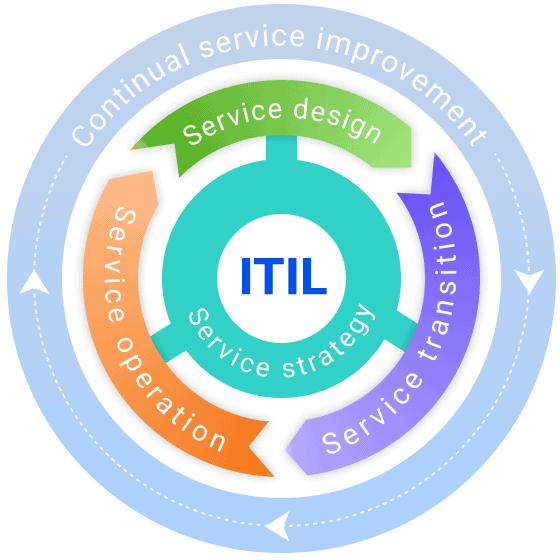
The typical visual representation of the ITIL lifecycle stages
How do you prove CSI produced anything? Convert the improvement into money before you present it. Take first contact resolution: at 1,000 tickets a month, moving from 70% to 85% removes 150 escalations a month. If an escalated ticket costs twice what a first-line resolution costs – measure your own multiplier rather than borrowing one – and first-line resolution runs at $22, that is $3,300 a month, or $39,600 a year, from a single metric. The arithmetic is unremarkable, and that is the point: a CSI register listing activities rather than avoided cost gets cut in the next budget round.
What are teams measuring instead of SLAs? Experience-level agreements are the visible shift. Reporting by TechTarget in August 2026 describes the move from SLAs to XLAs becoming more common through the year, with IT and cybersecurity leader Sue Bergamo framing it as “outcome-based ITSM”. You do not need to abandon SLAs to start. Add one experience measure per service, ask the same question after every resolved ticket, and report it beside the SLA number for a quarter before deciding which one your leadership actually reacts to.
The ITIL service lifecycle has many benefits for modern IT service management:
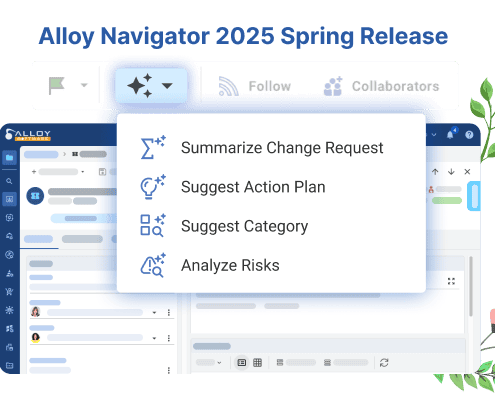
Alloy Navigator® is an ITIL-based software suite for IT Service Management and IT Asset Management designed and built with industry best practices and real-world customers in mind. It equips you with the tools to streamline and improve the efficiency of ITIL processes, such as Incident Management and Problem Management, Change Management, Knowledge Management, and more.
Here are our key strengths:
Connect with our sales team if you want to bring our product home!
You can explore different ITSM solutions in our article on the Best ITSM tools.
Back to other tips for implementing the ITIL service lifecycle:
When should you not implement it? Three situations. If your processes are not remotely mature – no ticket queue, no asset register, no owner for either – a five-stage framework adds vocabulary you cannot use yet. If nobody owns the decision or the budget, the project stalls at stage one; in Alloy Software’s own analysis, absent budget clarity and an absent decision owner are the two most reliable predictors of an ITSM project going nowhere. And if the team is one person with no capacity for setup, the honest answer is a help desk and an inventory, not ITIL. Weigh the implementation effort against the result before you start.
Which stage should you enter first? It depends on what already exists. The four starting points below cover most of what Alloy Software sees in mid-market IT teams of two to ten technicians managing a few hundred to a few thousand endpoints. Find the row that matches your situation, deliver the item in the third column within a quarter, and only then decide whether the full five-stage model is worth formalising.
| What you have today | Enter the lifecycle at | First 90-day deliverable |
|---|---|---|
| Spreadsheets, email, or a homegrown database; no service desk tool | Service Operation | One queue, one categorisation scheme, one weekly volume report |
| Help desk running, but no reliable asset data | Service Transition | Automated discovery covering 95% of endpoints, reconciled monthly |
| Inventory tool running, but tickets live in email | Service Operation | Ticketing linked to assets and users, with a request catalogue of 10 items |
| Both running; failing or fearing an audit | Service Design | Named service owners, SLAs per service, and an evidence-ready change history |
Five steps, in the order that works:
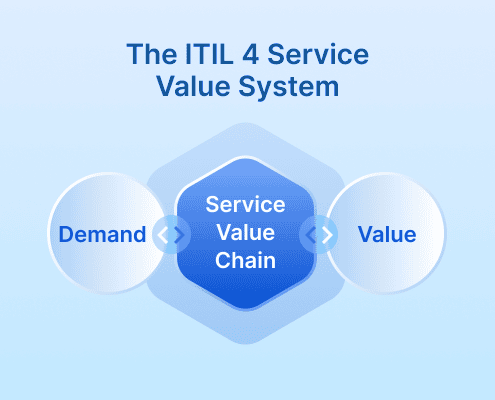
ITIL 4 introduces the Service Value System (SVS), which builds on the service lifecycle by adding new elements like the Four Dimensions model and the Service Value Chain. While the SVS doesn’t replace the service lifecycle, it provides a more complete approach to IT service management.
Organizations currently using ITIL v3 can benefit from moving to ITIL 4, as it offers a more flexible and adaptable framework for managing IT services in today’s complex and fast-paced digital world. To ensure a smooth transition, consider the following steps:
Did ITIL 4 replace the lifecycle or extend it? It replaced it. This is the most common error in older ITIL articles, including earlier versions of this one. ITIL 4, published in 2019, dropped the lifecycle as a structure and introduced the Service Value System, built from guiding principles, governance, the Service Value Chain, practices, and continual improvement. The work described by the five stages survives inside those components; the fixed left-to-right sequence does not. Teams move between value chain activities according to what the work needs – a high-risk change still goes to an approval board, a low-risk one ships immediately. Our separate guide to the ITIL Service Value System covers the components in detail.
What changed in ITIL Version 5, and when? PeopleCert released ITIL Foundation (Version 5) on 12 February 2026, with advanced modules rolling out in phases through March and April and a Managing Professional transition route for people already certified. No retirement date has been announced for ITIL 4, so the two schemes coexist. The substantive changes are a product-centric end-to-end lifecycle covering digital products as well as services, and a dedicated AI Governance module aimed at oversight, accountability, and risk in AI-enabled operations. Existing ITIL 4 certificates stay valid, and ITIL v3 exams have not been offered since 2022.
If you are moving from v3 vocabulary to the current framework, work through it in this order:
Start your trial with Alloy Software today
By mastering the ITIL service lifecycle and embracing its principles, you’ll be well-prepared to drive success in your organization’s IT service management efforts. Remember, the journey to excellence is ongoing, so stay committed to learning, adapting, and continually improving your IT services.
If you act on one thing from this guide, make it the categorisation review. It is the cheapest item on the list and it decides whether you can report anything useful twelve months from now.
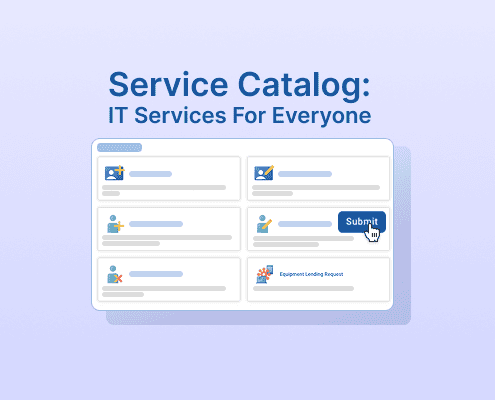
The service catalog is a key part of the Service Design stage. It provides a complete list of all IT services offered by the organization, along with their details and specifications.
The Service Strategy stage of the lifecycle focuses on understanding and aligning IT services with the organization’s overall goals. This ensures that IT investments support the organization’s objectives.
ITIL 4’s Service Value System builds on the service lifecycle by introducing new elements like the Four Dimensions model and the Service Value Chain. This provides a more complete and flexible approach to IT service management.
ITIL 4’s Service Value System replaced the five-stage lifecycle rather than sitting alongside it. It introduces the Four Dimensions model and the Service Value Chain, and organises work as six value chain activities that teams move between as needed rather than as a fixed sequence.
As a description of how services get built and run, yes. As current guidance, no. ITIL 4 retired the five-stage structure in 2019 and ITIL (Version 5) arrived in February 2026, so anyone certifying today learns the Service Value System and the product-centric lifecycle instead. The reason the five stages persist is that most organisations documented their processes under those headings and never renamed them. Keep the vocabulary if your team already speaks it, but do not present it to an auditor as the current framework.
Organizations can measure success by tracking key performance indicators (KPIs) such as service availability, incident resolution time, customer satisfaction, and cost savings. Regular reporting and analysis of these metrics can show the value of the ITIL service lifecycle and identify areas for continuous improvement.