Team Lead vs Manager: Setting the Boundaries
Should I code or run meetings? If I’m not allowed to approve new features, why am I to blame for delayed delivery? If that sounds familiar to you, this piece should be helpful.


Should I code or run meetings? If I’m not allowed to approve new features, why am I to blame for delayed delivery? If that sounds familiar to you, this piece should be helpful.
In modern IT teams, the line between a team lead and a manager rarely exists on paper. Gallup’s January 2026 span of control study found that 97% of US managers still carry individual contributor work alongside people leadership, and that they spend a median of 40% of their time on it. Gallup calls these people player-coaches; in IT we call them team leads. The dual load is not a temporary arrangement or a sign of a badly run team. It is the default setting. What actually varies between companies is whether anyone has written down where the team lead’s authority ends and the manager’s begins.
How do you, as an IT leader, address these challenges? Whether you’re a manager overseeing a team of developers, a team lead trying to balance responsibilities, or a software engineer looking for a clear career path, the solutions lie in understanding and redefining roles. Let’s explore practical ways to tackle these pain points.
First, let’s briefly define the “traditional” view of the two roles. Then, we’ll explore what has changed in recent years, shaking up the status quo and creating the dilemma between team leads and managers.
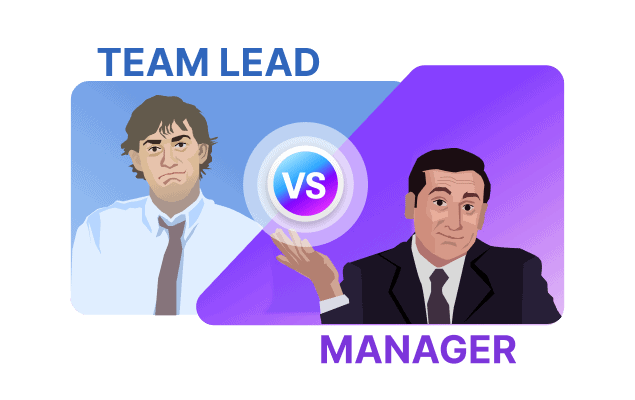
Historically the split was clean. A team lead was hands-on and lived inside the day-to-day operations of a single team: estimates, code review, standups, releases. A manager worked one level up, making sure the team’s activity matched what the business had committed to, and owning the decisions that cost money or change headcount. For anyone who watched The Office, Michael Scott is a manager and Jim Halpert is a team lead. That model held while teams stayed small and stable. It stopped holding when teams began growing faster than the supply of people qualified to lead them.

Building on this analogy, there’s an important point to consider: a team lead is more than a title; instead, it’s a traditional term used to describe an important role in IT. Those playing the role of a team lead may hold a title of a team manager, lead developer, or even head of development. Team lead is a commonly used term, and if you say it to anyone working in IT, they’ll very likely understand you.
The real meaning behind these titles is simple: a senior engineer with coding experience who leads a team of developers. How much coding stays in the job is changing fast. LeadDev’s Engineering Leadership Report 2026, based on 600 engineering leaders, found that 37% are doing more hands-on technical work than a year earlier, and among engineering managers specifically the share rose from 20% in 2025 to 35% in 2026. The technical half of the role is coming back rather than disappearing, which makes the boundary question harder, not easier.
A team lead’s typical day-to-day responsibilities include hosting team meetings, monitoring task progress, and adjusting the team’s workload when new projects arise. They ensure that tasks are completed on time and can step in to code if needed—or if they choose to do so. However, their primary role remains facilitating the overall progress of the team.
The role of a team lead has evolved beyond software development, extending to other business areas such as HR, marketing, and sales. In these functions—as well as in software development—a team lead is someone who performs core duties like marketing, sales, or HR while simultaneously managing their peers. For instance, a sales team lead (or sales lead) might handle sales calls alongside overseeing the team.
In this article, however, our focus is primarily on team leads in IT.
Another leadership position in IT is called manager. Managers stand above team leads in the hierarchy: developers report to team leads, and team leads report to managers. What a manager holds has grown quickly. Gallup’s span of control research shows the average US team went from 8.2 people per manager in 2013 to 10.9 in 2024 and 12.1 in 2025, while the median stayed at six. A minority of very large teams is pulling the average up. Gallup also reports that 37% of managers oversee fewer than five people, and 13% oversee 25 or more.
A manager’s role is to ensure the team’s goals align with the overall business objectives. This will include tasks such as performance reviews, hiring, firing, promotion, and budget allocation decisions.
How many people can a team lead carry before the job breaks? Gallup’s 2026 analysis points at the balance between managing and doing rather than at a magic number. Managers who spend up to 40% of their time on individual contributor work hold engagement at 37% no matter how many people report to them. Those who go past 40% slide as the team grows: 36% with fewer than five reports, 34% at 10 to 24, and 32% at 25 or more. Jim Harter, Gallup’s chief workplace scientist, puts it plainly: “Manager talent trumps span of control.”
To sum it up, here are the key differences between team leads and managers.
Table 1. Team lead vs manager: what actually differs
| What differs | Team lead | Manager |
|---|---|---|
| Type of work | Keeps day-to-day delivery of one team moving; needs current technical depth | Owns long-run goals; can come from a non-technical background |
| Work style | Works alongside developers and steps into the code when their expertise helps | Spends much of the day in meetings and stakeholder conversations |
| Place in the hierarchy | One team | Several team leads and several teams at once |
| Involvement in detail | Knows what was last posted in the #bugs channel | Does not go that deep, and certainly not for every team |
| Typical span (Gallup, 2025) | Median team is 6 people; 37% of leaders have fewer than 5 reports | 22% have 10 to 24 reports; 13% have 25 or more |
| Hands-on load | Usually above Gallup’s 40% individual contributor threshold | Expected to stay below it |
| Decisions owned | Task assignment, estimates, technical approach, escalation timing | Hiring, firing, promotion, compensation, budget, scope commitments |
To understand the difference, remember that managers do all the “less sexy” job, such as managing stakeholders’ expectations in terms of the “when’s” and “how’s” of the product, securing a buy-in of the resulting product from the C-level executives, negotiating budgets, and so forth. Team leads, however, have their backs when it comes to the operational, routine execution of everything that was planned and promised.
I said that it’s managers who do the less sexy job. To be impartial: whether the first or the second role suits you better, depends on your talents and choice. IT has historically been an industry with a higher than usual turnover rate, so as an IT specialist, changing from one role to another shouldn’t be a problem.
Dear Software Developer,
Meet Alloy Software, the firm behind Alloy Navigator, the all-in-one IT service management and IT asset management software solution.
We’ve been in the market for almost 20 years already, and we have customers who’ve been with us for 10, and 15 years. We think it says something about us as a partner.
We run this blog to promote our software solution, but also to attract top software development talent.
Our team is fully remote, with flexible working hours. We value curious minds, especially when it comes to implementing AI and other on-the-edge technologies.
Come join us to shape the future of IT service management!
Best,
Alloy Software Team
There are three reasons the distinction matters, and only two of them existed when this article was first published. The first is workload: team leads absorbed manager-level tasks without being allowed to drop delivery. The second is money, and it has changed direction since 2024. The third is structural and new. Through 2025 and 2026 companies started deleting the manager layer above the team lead, which leaves the lead holding both jobs whether or not anybody renamed the role.
Reason #1: As demand for digital transformation grew, team leads began feeling overwhelmed, having to juggle manager-level tasks while still maintaining a steady development pace within their teams.
In response to COVID-19, development teams expanded rapidly. Organizations needed more developers, and managing their work became an even bigger challenge than the shortage of tech talent itself. Due to the scarcity of team leads and managers, the boundaries between these two roles have become increasingly blurred. It’s now common for team leads to become involved in management-level decisions and responsibilities.
According to Ivan Samoylov, the CTO of Alloy Software, “In 2020, when COVID hit and software development teams rapidly expanded, new standards for role allocation emerged. Previously, a team lead was typically a senior software developer with leadership skills. But during this period, we started seeing team leads with only a few months of experience in IT. The demand for digital transformation was so high that the market couldn’t keep up.”
Around this time, Ivan suggests, the debate emerged over how broad a team lead’s responsibilities should be, and to what extent these responsibilities should fall to the next link in the chain—the manager.
Reason #2: Traditionally, team leads and managers were compensated differently, and leads get frustrated when the responsibilities arrive without the pay. What changed is that the management premium has largely evaporated at senior levels. An analysis of Levels.fyi submissions published in March 2026 puts the median total compensation of a Google L6 Staff Engineer at $579,576 against $590,551 for an L6 Engineering Manager, a gap of under 2%. If moving into management no longer pays meaningfully more, wanting the job becomes the only real reason to take it.
The exit signal is already visible in engineering. LeadDev’s 2026 survey of 600 engineering leaders found that one in three managers is considering giving up management to return to individual contribution, 45% are working more hours than a year earlier, and 41% say their team is less motivated than twelve months ago. Robert Walters research behind the term conscious unbossing, reported by Forbes in April 2026, found that 52% of Gen Z professionals do not want a middle management role at all, and 72% would rather grow through skills and expertise instead.
Reason #3: The manager layer above the team lead is being removed. Analysis by Live Data Technologies reported by Forbes in June 2026 shows manager headcount fell 6.1% between May 2022 and May 2025, while Korn Ferry found that 41% of employees say their organization has eliminated management levels and 43% say leadership alignment got worse as a result. Gartner’s 2024 forecast (one in five organizations using AI to cut more than half of middle management roles by 2026) was a prediction rather than a measurement. But when a manager disappears, their decisions do not. They land on the team lead.
Are the people absorbing this work prepared for it? Gallup’s State of the Global Workplace 2026 is blunt that people management is a skill, that few managers have natural talent for it, and that many have never had the training to coach a team. DDI’s Global Leadership Forecast, built on simulation assessments of more than 100,000 leaders, found that the share who feel very prepared to lead through change fell from 25% to 13% in five years. Tacy M. Byham, CEO of DDI, argues that organizations “must view change as standard operating procedure.”
As a manager, you might face team leads complaining about being overburdened, managing tasks they feel are outside their scope, or even feeling undervalued.
If you manage team leads, work the problem in this order rather than opening with a conversation about attitude:
If you’re a team lead feeling stretched thin, lacking clear boundaries, and being stuck in the middle, try these steps to communicate your issues to the manager:
When should you stop patching the combined role and split it? The signal is not headcount on its own. It is the point where the lead’s hands-on share stays above 40% while the team keeps growing, or where the lead starts owning outcomes they cannot approve: spend, hires, dates negotiated with stakeholders. Gallup’s data suggests wide spans can work when the manager has both the talent and the coaching time for it; both disappear when someone is still committing code for a third of the week.
Table 2. Keep the combined role, or split it
| Signal | Keep the combined role | Split into a lead and a manager |
|---|---|---|
| Team size | Up to roughly 6 to 8 engineers | Consistently above 10, or two or more separate teams |
| Lead’s hands-on share | Under 40% and stable | Above 40% while the team keeps growing |
| Decision rights | The lead can approve what they are held accountable for | The lead is blamed for outcomes they cannot approve |
| Hiring volume | Occasional replacement hires | Continuous hiring, onboarding and performance cases |
| Stakeholder load | One or two internal customers | Multiple stakeholders negotiating dates and scope |
| Weekly 1:1 coverage | Every report gets a meaningful conversation each week | 1:1s are the first thing cancelled when delivery slips |
| Cost of the fix | A written decision map is enough | A separate manager role, or a lead with reduced delivery targets |
If the table pushes you toward a split, split the decisions before you split the headcount. Write down who approves hires, who sets quarterly priorities, who talks to stakeholders about dates, and who signs off on tooling spend, then hand each whole category to one person. Most IT teams cannot afford a new manager this quarter, but every IT team can afford to stop having two people half-own the same call. The org chart can wait; the decision map cannot.
We plan to share more publications on career development in IT, so follow us on LinkedIn, X, or Facebook to learn more.