How to Improve Inventory Management
To reduce stockouts, optimize costs, and gain real-time control over inventory across modern business operations.



To reduce stockouts, optimize costs, and gain real-time control over inventory across modern business operations.
Inventory management is the systematic process of ordering, storing, tracking, and controlling the goods a business holds for production or resale. It encompasses every decision that determines the amount of inventory an organization carries, how that stock moves through the supply chain, and when new inventory should be procured to meet customer demand.
Effective inventory management matters because it directly influences operating costs, customer satisfaction, and cash flow. Organizations with poor inventory practices frequently encounter excess inventory that ties up working capital, stockouts that erode customer trust, and inaccurate inventory records that compromise decision-making. By contrast, a disciplined inventory management strategy enables organizations to maintain optimal inventory levels, reduce inventory costs, and free capital that would otherwise remain tied up in inventory.
This article presents proven inventory management techniques and actionable strategies designed to help organizations of every size improve their operations. Whether you are looking to improve your warehouse layout, implement new inventory management technology, or refine your supply chain management practices, the following sections offer a structured roadmap. Alloy Software provides solutions and tools that can support your organization throughout this journey.
Before exploring ways to improve inventory management, it is essential to identify the obstacles that undermine current inventory performance. The following challenges recur across industries and operating models.

Maintaining the right balance of inventory on hand is one of the most persistent difficulties in stock management. Overstocking results in excess inventory that consumes warehouse space and increases the cost of inventory carrying. Stockouts, conversely, lead to lost revenue and diminished customer loyalty.
Inaccurate demand forecasts create a cascading effect: organizations either hold too much product inventory or too little. Without reliable inventory data and analytics, demand planning becomes guesswork.
When physical inventory counts diverge from system records, organizations lose visibility into what they actually have. Manual inventory processes, such as spreadsheet-based tracking, are especially prone to errors that degrade inventory accuracy.
A poorly organized facility hampers receiving, put-away, and picking operations. Without optimized slotting and clear management processes, labor costs rise and order fulfillment slows.
Inconsistent supplier delivery times make it difficult to determine the inventory required at any given point, forcing organizations to carry additional safety stock or risk shortages.
Implementing effective inventory management strategies requires adherence to several foundational principles.
These principles form the foundation of any good inventory framework and should guide every subsequent initiative.
A robust inventory management process incorporates multiple complementary techniques. The following inventory strategies constitute the core of good inventory practices.
Accurate forecasting is the cornerstone of inventory planning. Organizations should leverage historical sales data, seasonal patterns, and market signals to project future demand. Collaborative planning with sales and marketing teams further enhances forecast quality, ensuring that the entire inventory strategy reflects commercial reality.
Not all inventory items warrant the same level of attention. ABC analysis categorizes items by value contribution, while XYZ analysis classifies them by demand variability. Together, these frameworks allow managers to prioritize management effort where it delivers the greatest return, concentrating on important inventory categories that drive the largest percentage of inventory value.
Safety stock serves as a buffer against uncertainty in demand and vendor lead times. To achieve inventory optimization, organizations should calculate safety stock levels based on desired service levels, demand variability, and lead-time fluctuations rather than using arbitrary rules.
Establishing precise reorder points ensures that replenishment orders are triggered before stockouts occur. The economic order quantity (EOQ) model and dynamic reorder policies help optimize inventory by balancing ordering costs against inventory holding costs. A well-calibrated reorder system is one of the best inventory management practices for maintaining the inventory you need without accumulating surplus.
Rather than conducting disruptive annual physical inventory counts, leading organizations implement targeted cycle counting programs. Cycle counts verify a subset of inventory records on a rotating schedule, sustaining high inventory accuracy without halting operations. This approach is far more efficient than attempting to reconcile the entire inventory at once, and it supports a perpetual inventory system.
Periodically reviewing and rationalizing your product catalog is a critical step in any inventory management strategy. Retire obsolete inventory and slow-moving SKUs, consolidate redundant variants, and ensure that every item in the catalog earns its place. This rationalization effort helps reduce inventory carrying costs and frees storage capacity.
Efficient receiving ensures that new inventory enters the system promptly and accurately. Technologies such as barcode scanning, RFID tagging, cross-docking, and immediate verification at the point of receipt minimize discrepancies and accelerate throughput. When you update your inventory records in real time during receiving, downstream operations benefit from accurate, current inventory visibility.
Implementing a new inventory management system can transform operational performance. When evaluating inventory software, organizations should consider the following capabilities.
| Capability | Description |
| Real-Time Tracking | Perpetual inventory visibility across all locations to track inventory movements as they happen |
| ERP Integration | Seamless connectivity with enterprise resource planning, accounting, and procurement systems |
| Barcode / RFID Support | Automated data capture that eliminates manual inventory entry errors |
| Analytics and Dashboards | Demand-planning tools, inventory optimization reports, and KPI dashboards |
| Multi-Location Management | Support for multiple inventory locations and facilities from a single platform |
Technology alone does not guarantee results. Organizations must also optimize their facility layout and operational processes.
These operational improvements complement your technology investments and deliver compounding returns over time.

An effective inventory management strategy extends beyond the four walls of the facility to encompass supplier relationships and procurement practices.
These procurement inventory strategies ensure that your supply chain remains responsive and reliable, even during periods of market volatility.
You cannot improve what you do not measure. The following KPIs enable organizations to measure inventory performance and identify areas for improvement.
| KPI | What It Measures |
| Inventory Turnover | How frequently the overall inventory is sold and replaced over a period, indicating efficiency |
| Days Sales of Inventory (DSI) | The average number of days it takes to convert inventory into revenue |
| Fill Rate / Stockout Rate | The percentage of customer orders fulfilled from available stock without backorders |
| Carrying Cost of Inventory | Total cost to hold inventory, including storage, insurance, depreciation, and opportunity cost |
| Order Accuracy / Cycle Count Variance | The degree to which inventory records align with actual physical counts |
Tracking these metrics allows leadership to improve inventory turnover, lower inventory carrying expenses, and ensure that business inventory decisions are grounded in objective data.
Adopting new inventory management strategies is essential, but success depends on disciplined execution. The following roadmap guides organizations from assessment through continuous improvement.
A mid-sized retailer implemented ABC analysis and continuous cycle counting, replacing annual physical inventory counts. Within six months, the organization reduced stockouts by 35% and lowered carrying costs by 18%. The retailer also retired the oldest inventory items that had been occupying valuable storage space.
A manufacturing firm adopted safety stock optimization and supplier collaboration initiatives. By aligning reorder points with actual lead-time data, the firm achieved improved inventory flow, reduced emergency orders by 40%, and cut overall inventory by 12%. This enabled the manufacturer to redirect capital previously held in lower inventory holdings.
An e-commerce company deployed an integrated inventory management system with barcode scanning and real-time dashboard analytics. The result: 99.2% order accuracy, a 25% improvement in inventory turnover, and seamless visibility across three warehouse locations. Managing your inventory with modern inventory systems proved transformative for their operations.
Immediate quick wins:
Mid-term projects:
Long-term investments:
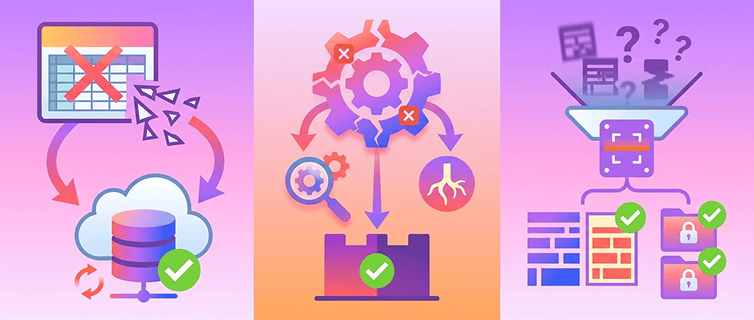
Overreliance on spreadsheets
Spreadsheets lack the scalability, real-time visibility, and audit controls that proper inventory control demands. Organizations should transition to dedicated inventory management solutions as they grow.
Ignoring root causes
Addressing symptoms rather than underlying causes leads to recurring problems. For example, increasing safety stock to compensate for supplier unreliability does not resolve the root issue. Investigate and correct systemic failures for sustained improvement.
Poor data quality
Even the most sophisticated systems will underperform if the underlying data is unreliable. Invest in data governance, regular audits, and automated data capture to maintain the integrity of your inventory records.
Effective inventory management is not a single initiative but a continuous discipline that spans demand forecasting, inventory control, operations, supplier management, and technology adoption. The strategies outlined in this article, from ABC analysis and safety stock optimization to perpetual inventory systems and advanced analytics, provide a comprehensive framework for organizations seeking to reduce costs, improve service levels, and optimize their supply chain.
We encourage every organization to assess its current state, identify the ways to improve your inventory performance that will deliver the greatest return, and begin with measurable pilot projects. Alloy Software stands ready to support your transformation with inventory management solutions and expert guidance. Explore our products and discover how the right inventory management approach can unlock efficiency, improve your inventory operations, and drive sustainable growth across your organization.