Asset Management Policy for IT Teams — Full Template



An asset management policy states who owns each item, what records must exist, and what happens before equipment is bought, moved, or destroyed. Most IT teams do not need forty pages. They need rules that survive an audit and a register matching reality.
An asset management policy covers ownership, classification, registration, approval thresholds, movement, and retirement of hardware, software licences, and subscriptions. It does not cover configuration baselines, patch schedules, access rights, or incident handling. Mixing those in produces a policy document nobody approves.
A written policy helps at three moments: purchase, audit, offboarding. Mobile device management is the boundary case: enrolment and wipe rules belong to an endpoint security standard, the phone to the asset register.
A one-page version is enough when one person approves purchases, no regulated data sits on the equipment, and nobody outside audits the records. A full policy becomes necessary once purchases need two signatures, disposal must be evidenced, or an assessor asks who approved it.
Headcount is a weak trigger. A clinic holding protected health information needs disposal records and named custodians whatever its size, while a firm with no regulated data runs a one-page ITAM policy for years.
Ten sections cover the ground. Each of them answers a question a technician or an assessor will ask, and each produces evidence: a name, a record, a signature, a date. Sections producing no evidence can be cut without weakening asset governance.
Purpose, scope, and audience define what the document covers and who follows it. State the asset types in scope, the sites and entities covered, the staff bound by the rules. Write exclusions beside them, or every BYOD question reaches the policy owner.
Four roles are enough. The asset owner is accountable across the item’s life, the custodian holds it, the user operates it, the approver authorises purchases and disposals. Name roles by job title, not by person, so the document survives staff changes.
Asset ownership normally sits with a department head, not IT. IT is custodian of a finance workstation, finance owns it and accepts the risk at audit.
Definitions and asset classification fix the vocabulary the document depends on. Define asset, consumable, licence, then set three tiers, critical, standard, low value, driving different handling rules. Without tiers every rule applies to every item and staff ignore the excessive ones.
Definition.
Asset, for the purposes of this policy: any item with a purchase value above the capitalisation threshold, or any item that stores, processes, or transmits company data, regardless of value.
The asset register needs enough fields to answer ownership, location, and lifecycle questions without a second lookup. Keep the count low enough that every field is filled at receipt, because a field nobody fills is worse than none. Asset identification rests on the serial number, the label serving asset tracking.
| Register field | What it holds |
|---|---|
| Asset ID | Printed on the asset tags |
| Serial number | Manufacturer serial, for reconciliation |
| Asset owner | Accountable department head |
| Custodian | Person or team holding it |
| Status | Deployed, in stock, in repair, retired |
| Location | Site, room, or named user |
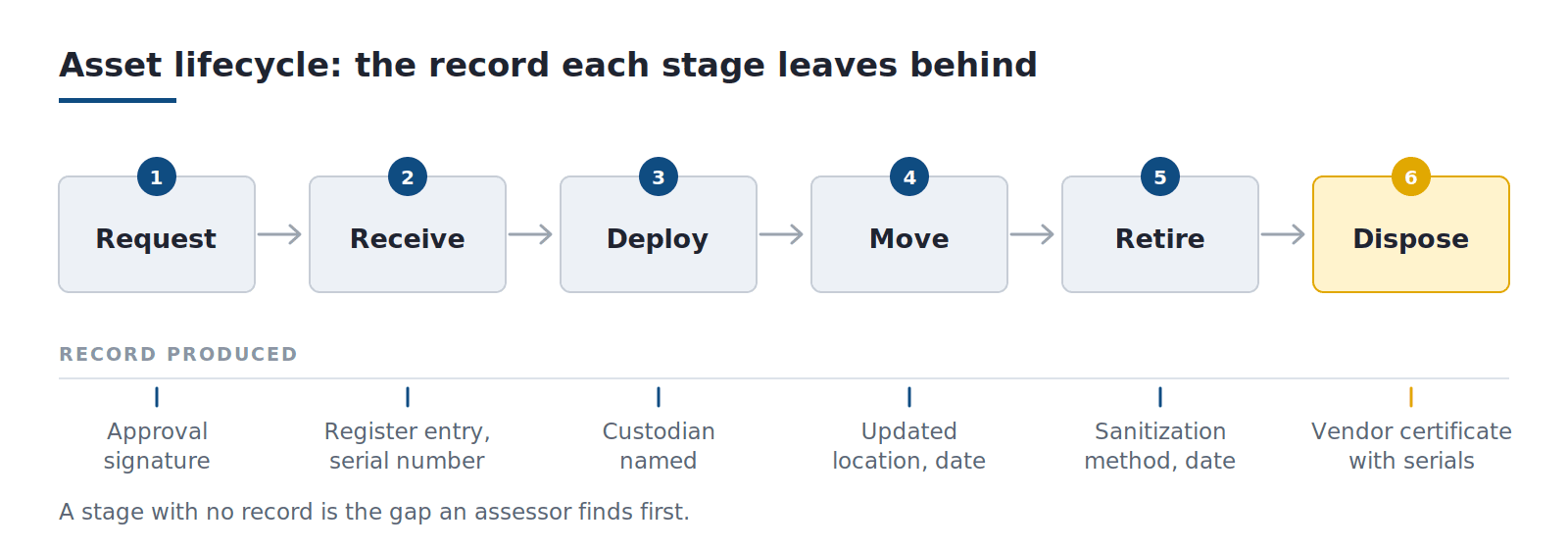
Request, approval, purchase, and deployment describe the path from a stated need to a registered item. Set thresholds in currency rather than seniority, with management approval for anything changing the annual licence position, and create the register entry at receipt, not deployment.
Asset maintenance, moves, and transfers keep the register aligned with reality. Require an update within a fixed window after any move between sites, users, departments. A formal change management process should cover moves affecting production services, not laptop reassignments, because routing everything through change control gets both bypassed.
Loss, theft, and unreturned equipment need a reporting deadline, a named recipient, a stated consequence. Require reporting within 24 hours to the service desk and policy owner, because remote wipe and insurance claims run on time limits. Deducting value from final pay is lawful only in some places.
Asset retirement requires proof, not a status change. Record the sanitization method, the date, the responsible person, the destination for every item. NIST SP 800-88 Rev. 1, published December 2014, defines Clear, Purge, and Destroy and supplies a sanitization certificate.
Asset disposal through a third party does not transfer accountability. Keep the vendor certificate with serials listed: one giving a quantity and no serials proves nothing. When an asset is retired but kept as a spare, set status retired, do not delete it.
Exceptions and waivers give the document somewhere to put the cases it cannot cover. Every waiver needs a requester, an approver, a compensating control, and an expiry date. Permanent exceptions are policy failures in disguise and should trigger a revision.
Policy enforcement states what happens when rules are ignored, who checks asset control, how often. An annual review with a named policy owner is the minimum, a quarterly spot check of a fixed sample catches drift. Revision history is what assessors open first.
The asset management policy template below is complete text, not an outline. Adjust the thresholds to the ones Finance already uses, delete clauses that do not apply, keep the numbering, so an audit finding can cite a clause rather than a paragraph.
Four functions need to sign: IT, finance, legal or compliance, HR. IT drafts, finance confirms the capitalisation threshold, legal checks the payroll deduction clause, HR owns offboarding. Review time follows the slowest approver’s calendar, so plan for approval to outlast drafting.
Four functions reviewing in parallel finish in weeks. Routed sequentially through a monthly committee, the same document takes months.
Policy sections map to named controls, not to standards in general. ISO 27001:2022 Annex A covers inventory, acceptable use, return, secure disposal. SOC 2 criteria cover the inventory of information assets and data removal before disposal. HIPAA wants a record of hardware movement.
| Control | GDPR requirements | ITSM setting |
|---|---|---|
| Access | Only what each role needs | Separate IT and HR queues, deny by default |
| Data encryption | In storage and in transit | TLS, AES-256 at rest, field level for Article 9 |
| Logging | Who read and changed what | Immutable audit trail, reviewed |
| Retention | Limited to the stated purpose | Deletion rules per category, attachments included |
Two dates change how asset management policies map to that table. Certificates against ISO/IEC 27001:2013 stopped being valid after 31 October 2025 under IAF MD 26:2023, so use the 2022 numbering. ISO 55001, the international standard for asset management, is heavier than most teams need when information security drives the work.
The HIPAA accountability specification is still only addressable. The Security Rule proposed at 90 FR 898 on 6 January 2025 would remove that category and require a written technology asset inventory and network map reviewed at least every 12 months. It remains proposed as of August 2026, so healthcare policies should assume it lands.
A register stays accurate only if something reconciles it against observed reality. Network discovery, endpoint agents, purchase records should each be compared against the asset inventory on a fixed schedule. A yearly stocktake finds the gap once and says nothing after.
Reconciliation should produce a work queue, not only a dashboard. A monthly list of devices seen on the network but missing from the register, plus entries unseen for 60 days, gives someone something to clear. Good asset management is how fast you find a device.
Asset management policies decay for three reasons: the register stops matching reality, the approval thresholds no longer match hardware prices, and the named roles leave. All three are maintenance failures, and none of them are fixed by rewriting the text.
Thresholds are written in the prices of the year they were signed. As costs move the same amount buys less, requests route higher than intended, staff split purchases. An effective IT asset management policy has its numbers reviewed annually.
Two to six pages covers most IT teams. Anything longer usually contains a procedure that belongs in a runbook, where it changes without a new approval round. A clear policy states the rules, the roles, and the evidence each rule produces.
Yes, provided the classification tiers, approval thresholds, and retention periods are replaced with the ones the company actually operates. Generic policy templates fail at audit when they cite controls nobody runs. Keep only clauses you can evidence: the safer best practice.
IT owns the policy and the process, departments own their equipment. That split leaves proper management of purchasing with the budget holder who defends the spend, while asset security, records, and reporting stay central. Without it every department builds its own register.
Yes, in short form. Even a one-page version should name the stages from request to asset retirement, because the lifecycle ties the register to the budget. Nobody chases retirement, since no user waits on it, and that is where modern IT asset management records stop.
A strategy sets the targets: refresh cycles, cost per user, tolerated risk. Asset management policies make those reachable by naming who approves a replacement asset, and when management and replacement follow age not failure. A strategy without a policy is numbers nobody acts on.