ITAM vs CMDB: Differences, Overlap, and When You Need Both
Optimize ITSM with effective asset & configuration management.


Optimize ITSM with effective asset & configuration management.
Organizations frequently debate ITAM vs CMDB because both disciplines describe the same environment from different angles. A CMDB gives operational context – how services, applications, and infrastructure relate – so teams can restore service fast and manage risk. ITAM focuses on financial accountability, control, and governance across the asset management lifecycle, from request to retirement. In practice, the strongest ITSM operating models connect both. When ITAM and CMDB work in tandem, you reduce blind spots, prevent downstream failures, and improve audit readiness. Alloy Software supports this approach by unifying ITSM, asset management, and CMDB capabilities in one platform – helping teams balance service reliability with cost and compliance.
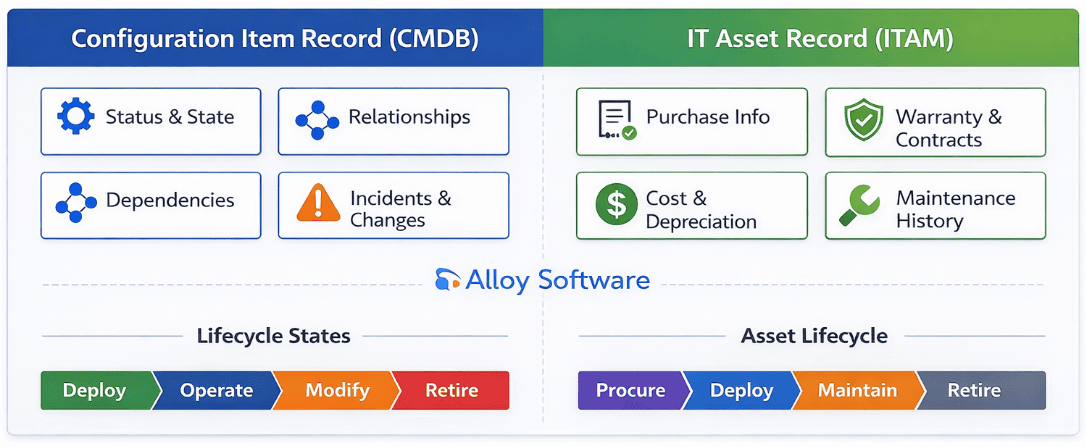
ITAM is a discipline and an operating model for governing technology asset spend, risk, and value. It typically covers hardware and software across procurement, deployment, usage, and disposition, including contracts, warranties, and license entitlements. In other words, ITAM focuses on ownership, cost, and control, using consistent asset records and an asset register as the system of record for each managed object. A mature ITAM solution also emphasizes lifecycle governance, policy, and evidence – so that decisions are defensible during an audit.
A CMDB is the operational system of record that organizes assets and configuration items in a service context. The term configuration management database is commonly used to describe a database that stores configuration entities and the relationships between them. In a CMDB, a configuration item (often abbreviated as CI) represents something you need to manage to deliver or support a service – an application, server, cloud resource, network device, or a business service itself. Many teams also maintain cis for service components and dependencies. The core value is not just attributes, but relationship mapping: what depends on what, where risk propagates, and which changes may create impact.
The key differences between CMDB and ITAM begin with purpose. A CMDB is designed to support operations: it underpins incident triage, root cause analysis, and change management impact analysis. ITAM is designed to support governance: financial optimization, risk control, and lifecycle management across procurement-to-retirement. Put simply, a CMDB cares about service context and relationships; ITAM cares about accountability and cost.
Second, the data model differs. ITAM is centered on the “asset” concept – who owns it, where it is, what it costs, what contracts apply, and what the expected asset lifecycle should be. That includes inventory and asset inventory accuracy, depreciation, and license compliance for each software asset. In contrast, a CMDB is centered on “service configuration,” where the configuration item and ci relationship graph is the main product. Even if the same device appears in both, the records answer different questions.
Third, ownership and governance differ. Asset management is frequently owned by IT finance, procurement, security, or a dedicated governance function. configuration management process ownership often sits with service operations, architecture, or ITSM governance. The difference between a CMDB record and an asset record is therefore not merely fields; it is accountability, stewardship, and the way data is validated and used day-to-day.
Finally, lifecycle behavior differs in practice. ITAM expects planned updates – purchases, moves, warranty changes, contract renewals, refresh cycles – managed as part of an asset management process. A CMDB expects operational changes – patches, configuration drift, service dependencies, cloud elasticity – tracked continuously so the relationship map stays usable. If you do not automate capture and reconciliation, both repositories degrade, and you start to see duplicate records and contradictory truths.
| Dimension | ITAM | CMDB | Notes |
|---|---|---|---|
| Primary goal | Financial control, compliance, and optimization | Operational visibility and service context | Asset management optimizes value; CMDB reduces downtime risk. |
| System of record | Asset register and asset records | CI repository and relationship model | One object can be both an asset and a configuration item. |
| Core objects | Devices, software assets, contracts, users | Services, apps, infrastructure, CIs | “Asset” and CI overlap but are not identical. |
| Relationships | Useful, but secondary | Primary feature (service-to-component mapping) | CMDB dependency mapping is a key differentiator. |
| Ownership | Governance, finance, procurement | Operations, architecture, ITSM governance | Clear responsibility assignment prevents drift. |
| Change focus | Planned lifecycle changes | Operational service changes | Tight coupling improves change management. |
| Data cadence | Periodic updates and reconciled discovery | Continuous updates and relationship validation | A CMDB can degrade quickly without automation. |
| Metrics | Cost, utilization, license compliance, refresh | Service impact, criticality, risk propagation | Complementary value signals. |
| Reporting | Spend, risk, warranty, contract, audit evidence | Impact analysis, service health, dependency insights | Different audiences need different views. |
| Tooling | ITAM features: contracts, warranties, chargeback | CMDB features: relationships, service models | Alloy provides both in one platform. |
| Typical output | Budget and governance decisions | Faster restoration and safer change | Enables better decision-making. |
| Failure mode | Poor visibility into value and compliance | Broken relationship map, misleading impact analysis | Both require governance and reconciliation. |
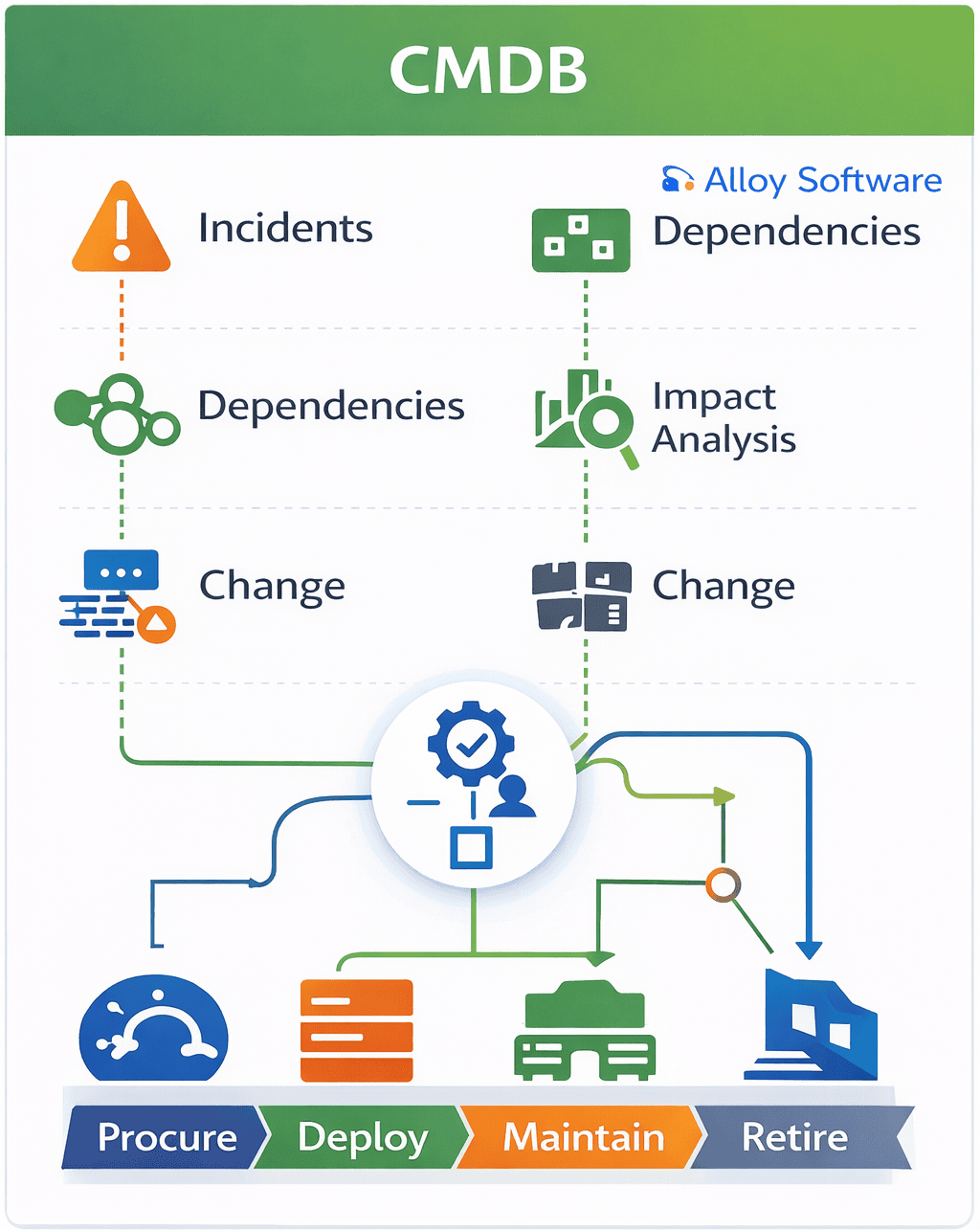
A well-governed CMDB shines where operations require context and speed. During incident management, responders need to know what changed, what is upstream, and what business service is at risk. If your CMDB maps services to their components, teams can identify likely blast radius within minutes rather than hours – especially in complex hybrid estates. That matters because downtime economics can be extreme: ITIC’s 2024 research reports that for over 90% of mid-size and large enterprises, one hour of downtime exceeds $300,000.
Problem management benefits similarly. When recurring incidents appear, teams use the CMDB to analyze patterns across related CIs – for example, which applications depend on the same middleware layer or which cloud services share a common network path. The dependency graph is essential for isolating the real constraint and prioritizing permanent fixes.
A CMDB is also central to safe change management. When teams plan a patch, migration, or configuration adjustment, using a CMDB supports impact analysis and stakeholder communication: which services will be affected, which owners must approve, and which maintenance window is suitable. This is where the CMDB provides operational confidence: the relationship model allows approvals and scheduling to be based on real impact rather than assumptions.
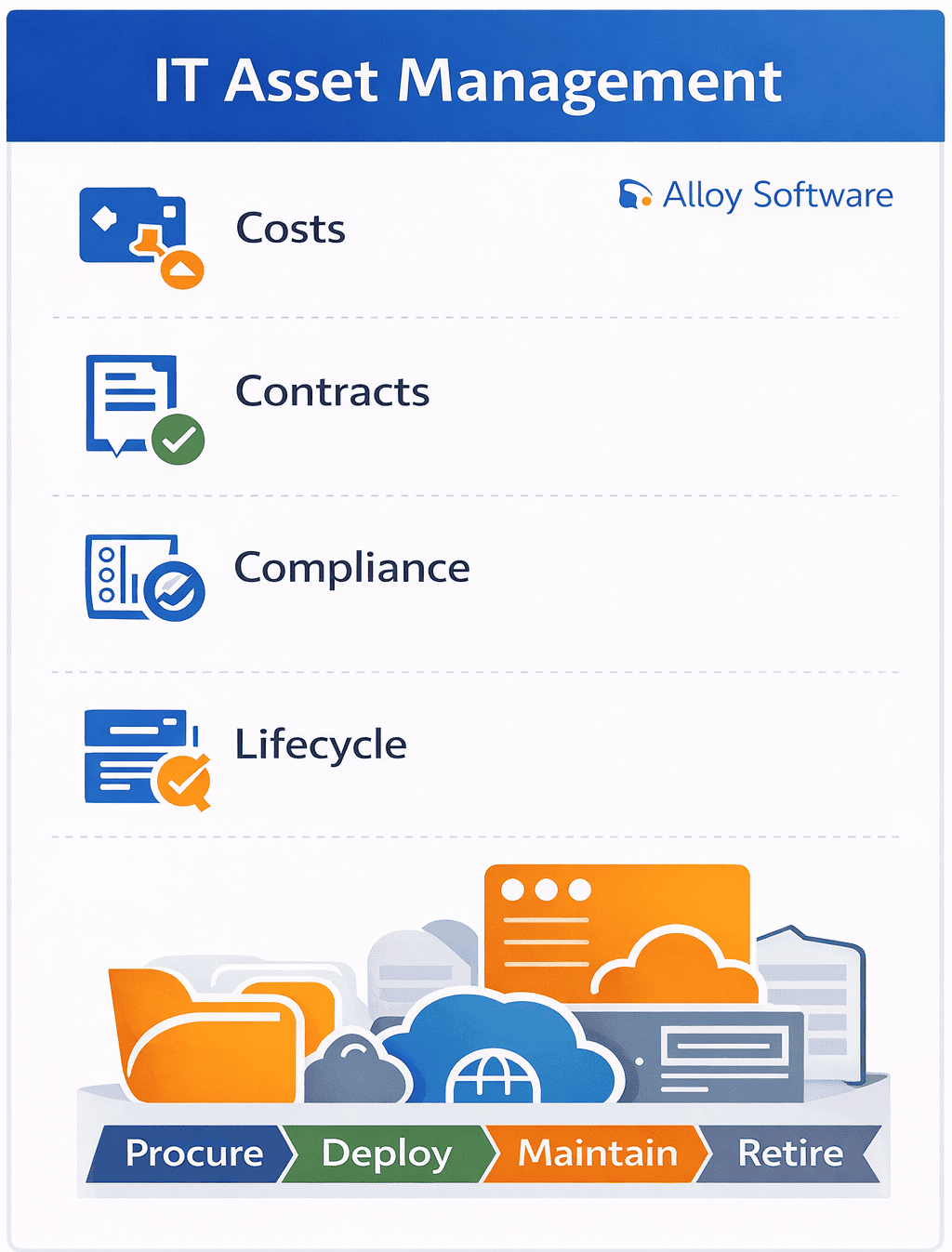
ITAM wins where organizations need financial clarity, contractual control, and compliance evidence. It answers questions such as: What do we own? What do we lease? Which warranties are expiring? Which devices should be refreshed? Which license positions are over- or under-provisioned? These questions are foundational to cost governance and risk management.
A strong asset management discipline is also where organizations capture contract terms, entitlements, and renewal obligations – often through a contract lifecycle management system or integrated contract management. This is not “nice to have” license governance is a direct cost lever: Gartner has stated that organizations can cut software spending by as much as 30% by applying software license optimization practices and SAM approaches. That figure is a practical anchor for why an ITAM solution should be treated as a business capability, not merely a tracking spreadsheet.
From a lifecycle perspective, ITAM provides governance across procurement, deployment, and retirement. That includes policy-driven controls for movers/leavers, hardware refresh planning, and secure disposition. It also strengthens audit readiness by preserving traceability: purchase evidence, assignment history, and change history. Done properly, asset management helps organizations demonstrate compliance, enforce standards, and reduce the risk of financial leakage.
The highest-performing organizations do not force a single repository to answer every question. Instead, they establish one shared identity model and two complementary views. Practically, CMDB and ITAM integration requires agreement on identifiers, normalization rules, reconciliation logic, and ownership boundaries. The objective is not duplication; it is coherent truth.
A pragmatic pattern is:
A simple conceptual diagram (textual) helps clarify intent:
This is also where teams reconcile assets and configuration items without inflating scope. Not every CI must be a capitalized asset, and not every asset must be a CI with deep service relationships. The difference between ITAM and CMDB is precisely that the value models differ, so the integration should preserve those differences while connecting them.
Alloy Software supports an integrated operating model where CMDB and asset management coexist in the same platform, enabling consistent workflows, shared identifiers, and governance without over-engineering.
Integration only works if data quality is managed as a capability. Teams should treat data as a product with measurable objectives: accuracy, completeness, and timeliness. A common rule-of-thumb target discussed in industry practice is ~97% accuracy for CMDB and asset repositories – high enough to trust, realistic enough to sustain with process discipline.
Recommended KPIs:
Discovery must also be designed appropriately. If discovery is partial, both CMDB and ITAM degrade. If discovery is uncontrolled, the database fills with irrelevant noise and relationships lose meaning. Benchmarks should be tied to service criticality: high-impact services require tighter accuracy and faster refresh cycles.
Finally, data quality requires explicit measurement and response. Do not measure for reporting alone – measure for action. When thresholds are breached, workflows should automatically trigger remediation tasks, approvals, and ownership accountability. This is one of the most practical ways to automate governance and keep repositories useful.
When evaluating CMDB solutions and an ITAM tool, avoid feature checklists that ignore governance reality. The most important criteria are those that keep data usable.
Recommended evaluation criteria:
What’s the difference between ITAM and CMDB?
ITAM governs cost, ownership, and compliance. A CMDB governs operational context and relationships for services. They overlap, but answer different questions.
When should I use CMDB vs asset management?
Use a CMDB for service impact and change/incident context. Use asset management for financial governance, lifecycle, and compliance evidence.
Is CMDB vs ITAM an “either/or” decision?
Not usually. Most mature ITSM programs benefit from both, connected through shared identifiers and reconciliation rules.
Why do teams struggle with CMDB vs spreadsheets?
Spreadsheets cannot sustain relationship integrity, audit trails, or automation at scale. A CMDB and ITAM platform supports governance and operations.
How do I reduce dependency risk in operations?
Model critical dependencies in the CMDB, validate them continuously, and align change management approvals with impact analysis.