What are 3 Types of SLA: Types, Service Levels Explained
Understand Service Level Agreements (SLAs): Explore types of SLAs between a service provider and a customer. Learn about service levels & service delivery.


Understand Service Level Agreements (SLAs): Explore types of SLAs between a service provider and a customer. Learn about service levels & service delivery.
An SLA (Service Level Agreement) outlines the expectations for a particular service. The SLA provides details on what services a provider will offer, how it will be measured, and what the provider will do when targets aren’t met. From a practical view, the SLA manages the expectations of the level of service, quality of service, and accountability. It often includes such service level remedies like service credits. A good SLA will reduce the risk of ambiguity, serves to protect both parties, and establish a baseline to ensure the reliability of service deliverables.
A service level agreement is often a formal, measurable agreement between the service provider and a customer. It states what sort of service is to be provided, and what level of service is expected on the customer end. In most cases, there is an SLA documented within a wider set of the terms and conditions of the service, or within a contract submission, but it is fundamentally an operational document which describes objectives, measurement parameters, reporting structures, and remedies for gross service failures. In plain terms, the SLA is a contract that specifies how the provision of service will be measured and the measures that will be used to do so, such as response time, resolution time, and/or overall service uptime.
Most SLAs detail: scope and exclusions (what specific service is covered), role and responsibility delineation of service provider and consumer, measurement of service (includes tools, data sources, definitions), frequency of reporting, pathways for escalation, and service credits or corrective actions tied to consequences of not meeting the SLA. Well constructed SLAs specify a service level objective (SLO) for each measurable and definable SLA, which helps integrate daily operations with measurable service attainment and clear parameters around acceptable service.
In practice, many organizations operationalize a service level agreement inside an ITSM platform. Alloy Software enables teams to configure SLAs, link them to tickets and requests, and monitor SLA metrics and KPIs through dashboards and scheduled reports – supporting consistent service level management.
It is also useful to clarify SLA and OLA. OLA (operational level agreement) is an internal commitment among internal teams, usually within the same service provider, to support the external service level agreement. OLAs belong to the service management discipline and address internal dependencies that need to be in place to meet SLA targets visible to customers.
Industry references often consolidate the types of SLAs into three primary categories: customer-based SLAs, service-based SLAs, and multi-level SLAs. These types of SLAs form the core of service level agreements you will encounter within ITSM and enterprise service delivery frameworks.
SLAs, in essence, are measurable commitments, SLAs help translate business expectations into operational targets. The selection of the type of SLAs, is to a large extent, a matter of scale, variability and level of governance.
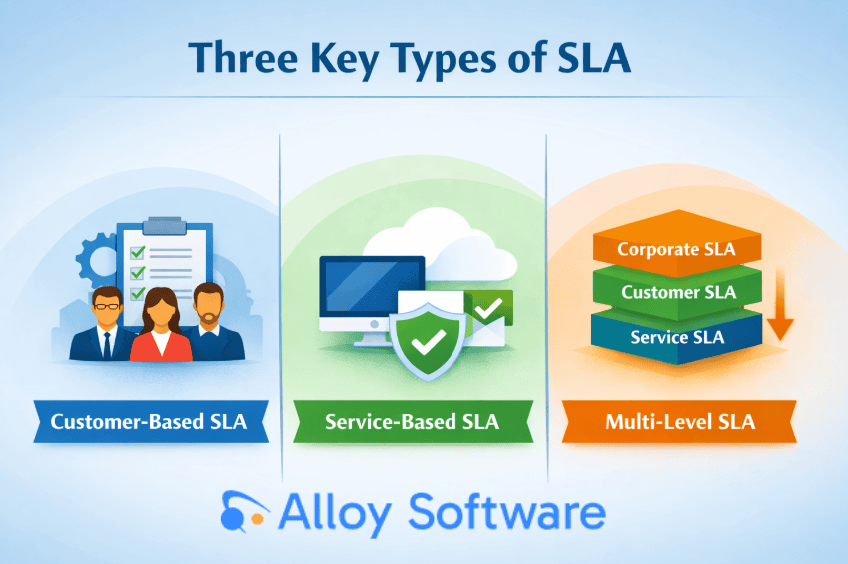
A customer-based model focuses on one customer, one department, or one internal business unit at a time. In this case, a customer-based SLA involves separate service level agreements for each relevant customer that combines several services that are managed and delivered as one. For instance, a customer may have access to service desk support, device provisioning, application support, and onboarding workflows, but the SLA will center on that customer’s service desk support, device provisioning, application support, and onboarding workflows. In practice, customer-based SLAs are used when one unit has specific compliance concerns, particular operational time frames, or a more significant criticality footprint than the others.
The service level flexibility is a significant customer SLAs’ benefit. It allows the service provider to adjust service levels to what that specific customer values, and the customer aligns the SLA to definitely value it as a business relevant instrument instead of a random generic SLA. With this model, there is often a greater standalone value in one SLA than in others, for example, saying which incidents are P1 incidents for that customer, what the escalation model is, and what the business impact is. There is a trade-off of increased management overhead, however. It is particularly evident when the number of customers increases, as having several differing SLAs raises complexity in reporting, tools, and governance.
A practical example (illustrative, commonly used targets – your SLA would vary by service and environment):
This structure helps ensure the service provider is meeting commitments that are meaningful to that specific customer.
Done well, it can directly improve service outcomes by prioritizing what matters most to that business unit. Done poorly, it can produce fragmented reporting and inconsistent governance across consumers. A good SLA in this model uses consistent metric definitions, disciplined reporting, and clear ownership for every aspect of service included.
A service-based model is built around one service with one set of targets for everyone who consumes it. This approach is ideal when a service offered is standardized and repeatable – for example, email, device provisioning, identity lifecycle support, or a standardized collaboration platform. The primary value is simplicity: one SLA, one measurement approach, one reporting model, and a consistent baseline of service levels for all consumers. It reduces negotiation overhead and supports mature service catalog practices.
In a service-based design, the service provider publishes the targets for the service to be provided, and each consumer agrees to use that service under those conditions. The commitment is not “per customer,” but per service. This is useful when you have many consumers and the operational capability is consistent, enabling clear benchmarking of service provider’s performance.
An industry-standard example is an availability commitment: for a core shared platform, an SLA that guarantees service availability of 99.9% uptime is a common format. In this case, service will be available for nearly all business hours across a month, and downtime allowances are explicitly defined (including maintenance windows, exclusions, and incident classification rules). This does not mean every consumer experiences the same perceived quality, which is why governance should include both operational performance metrics and customer-experience signals where appropriate.
Because a service-based SLA can apply across many consumers, it is common to pair it with internal OLAs to ensure the internal supply chain is stable. In mixed environments – where an internal team integrates with cloud service providers or other vendors – this model is also frequently used for external service dependencies, including an external service agreement that ensures upstream targets support downstream commitments.
A multi-level model exists to handle complexity: multiple consumer groups, different priorities, different risk levels, and multiple delivery constraints. In many organizations, a single set of targets is either too rigid (hurting high-criticality consumers) or too generous (over-committing costs for low-criticality users). A multilevel SLA (also written as multi-level SLA) is designed to solve that problem through layered commitments.
A common model has three layers: a corporate/global baseline, a customer layer, and a service layer. The corporate baseline sets organization-wide rules for measurement and reporting (e.g., incident priority definitions, support hours, and standard reporting cadence). The customer layer may add customer-specific requirements (e.g., VIP handling, compliance rules, or executive escalation paths). The service layer defines targets per service (availability, support windows, and operational measures). This structure directly supports different levels of service while keeping definitions consistent across the organization.
Example: a corporate baseline might specify standard definitions and reporting, plus a baseline incident response. Then a VIP customer layer might tighten response expectations and add executive escalation for certain issue categories. Meanwhile, the service layer could define different targets for different services – device provisioning versus application support – without rewriting the entire agreement. The result is a manageable hierarchy of service levels that scales to large organizations and helps ensure you can meet the SLA across varied needs.
This model is also helpful when delivery spans regions, business units, or hybrid delivery teams, including customer service providers, internal operations, and third parties. It keeps the level of performance transparent while minimizing duplication.
Some guidance materials mention internal SLA as a separate category. In practice, many frameworks treat “internal” not as a distinct SLA type, but as a customer-level variant: the “customer” is an internal business unit rather than an external client. That framing aligns well with the customer-based model: the agreement is still between the service provider and the customer, but both parties are inside the organization.
This clarification reduces confusion for readers who encounter “internal SLA” in the market. It also reinforces a practical point: whether internal or external, SLAs succeed when they clearly define responsibilities, measurement, and remedies. In other words, SLAs are also governance instruments, not just operational scorecards. If you are creating SLAs for internal consumers, the same principles apply: choose measurable commitments, define ownership, and ensure the reporting is credible and actionable – so that SLAs make operational performance visible and manageable.
A high-quality SLA relies on measurable targets. Common SLA metrics typically include availability, responsiveness, restoration speed, and service quality indicators. These are often expressed as SLA metrics and KPIs (or more broadly, metrics and KPIs) so the organization can track compliance, identify bottlenecks, and manage risk. Importantly, SLA metrics must be measurable, auditable, and tied to the actual user experience to avoid misleading “green dashboards.”
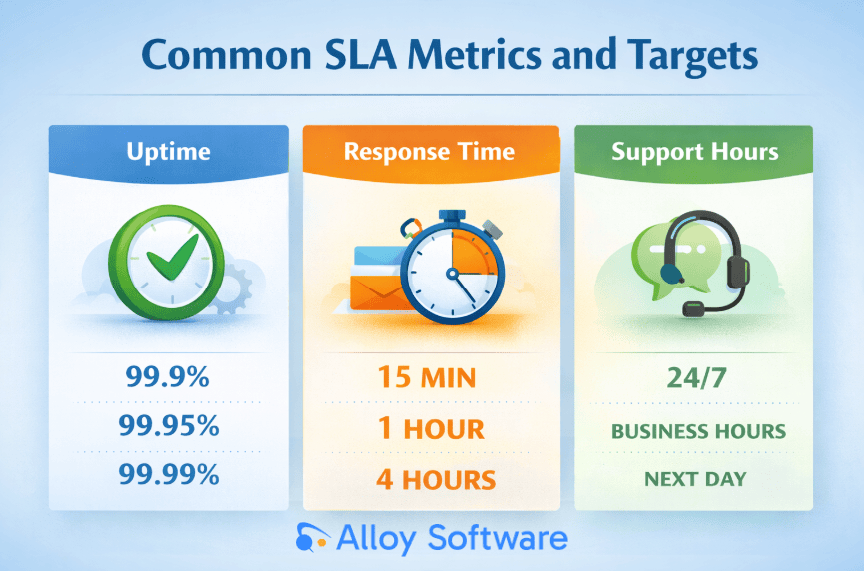
Availability targets are often expressed as uptime percentages. Here is a reference table translating typical targets into approximate monthly downtime (30-day month), often used to communicate expectations around service availability:
| Availability Target | Approximate Downtime per Month |
|---|---|
| 99.90% | ~43.2 minutes |
| 99.95% | ~21.6 minutes |
| 99.99% | ~4.32 minutes |
These are example service levels. The appropriate target depends on the business impact, the cloud service or on-prem architecture, and the cost of resiliency.
Separating response time from restoration is a best practice. Response time measures how quickly the service provider acknowledges and begins working. Restoration (often tracked via MTTR) measures how quickly the service is restored to normal. SLAs frequently define both because a fast acknowledgement without meaningful progress does not protect business operations, and slow acknowledgement erodes trust even if resolution is fast.
Depending on maturity, SLAs may include first contact resolution, backlog size, change success rate, or customer satisfaction signals as proxies for quality of service. These can be valuable performance metrics, but only if they reflect actual service performance and are collected consistently. Mature organizations treat these as part of service level management, ensuring measurement definitions, reporting cadence, and improvement actions are governed – so SLAs remain credible instruments for continuous service delivery improvement.
Remedies in SLAs should be proportional, measurable, and operationally feasible. Common remedies include service credits (financial or contractual credits tied to missed commitments), root-cause review obligations, and corrective action plans. In regulated environments, remedies may include formal breach notifications and documented remediation timelines. The goal is not punishment; it is creating a disciplined mechanism to maintain agreed service levels and drive improvement.
Reporting should be explicit. Many organizations report monthly for operational visibility and quarterly for executive review, but the right cadence depends on volatility and business criticality. A common risk is the “watermelon effect”: dashboards that look green at a high level while users feel red in daily experience. Avoiding this requires targets that reflect reality, clear definitions for what counts as downtime, and reporting that covers both outcomes and leading indicators.
A practical reminder: the agreement should clarify how to use service and how incident categories map to targets, especially for complex environments or when delivery spans multiple providers. This is where successful service level agreements separate themselves from generic templates.
Choosing among different types of SLAs is a governance decision as much as an operational one. Use the checklist below to select a suitable structure:
Ultimately, the best SLA is the one you can consistently deliver, measure, and improve.
The three core SLA models – customer-based, service-based, and multi-level – form the foundation of successful service level agreements. Each model defines measurable commitments that help ensure reliable service delivery. With appropriate tools such as Alloy Software, organizations can operationalize SLAs, track service levels, and maintain governance across complex environments.
SLAs make sure both parties share one definition of success, including measurable targets, reporting, and remedies – so the service to multiple teams remains predictable and accountable.
Not always. Many SLAs include service credits or corrective actions, but the type of agreement may focus on transparency, governance, and improvement rather than financial penalties.
Look for clear definitions, reliable data sources, and trends. SLAs help set expectations, but reporting should reveal real user experience – not just compliance against narrow metrics.
Yes. A service-based approach can cover a particular service with consistent targets for all consumers, especially when the service provided is standardized and measured consistently.
If teams can see the SLA, act on insights, and the service provider is meeting commitments consistently – while customer impact improves – then the SLA is functioning as intended.