ITSM Strategy For Long-Term Success
From reactive operations to strategic value: a comprehensive guide to building an ITSM strategy that enables business agility and resilience
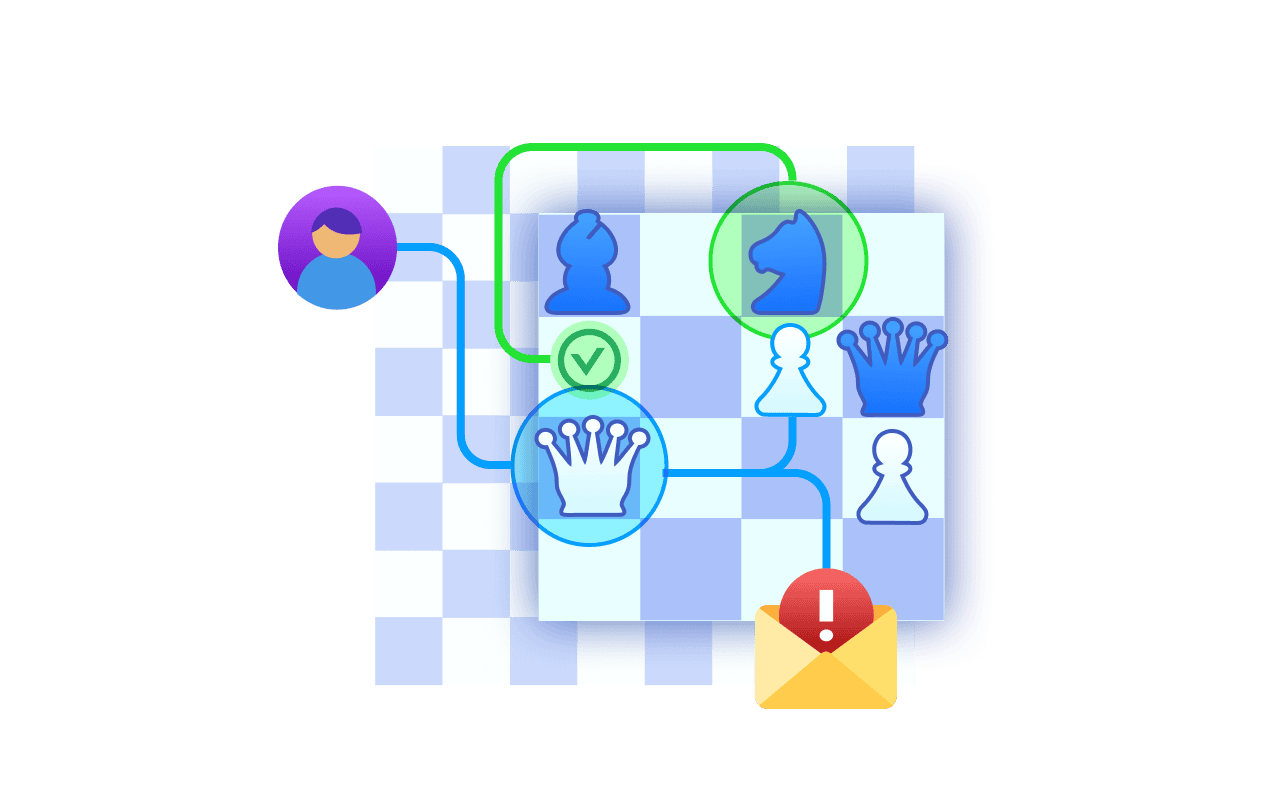


From reactive operations to strategic value: a comprehensive guide to building an ITSM strategy that enables business agility and resilience
In many organizations, ITSM practices evolved organically. A major outage led to creating an IT team. An Excel file for tracking assets was created after a laptop went lost during office clearance. No such thing as ITSM strategy was spoken about.
However, sooner or later, without a unified ITSM strategy, things start falling through the cracks. Requests are scattered across email, phone, and sometimes even sticky notes.
Organizations rarely decide to operate without an ITSM strategy. More often, they simply grow without one.
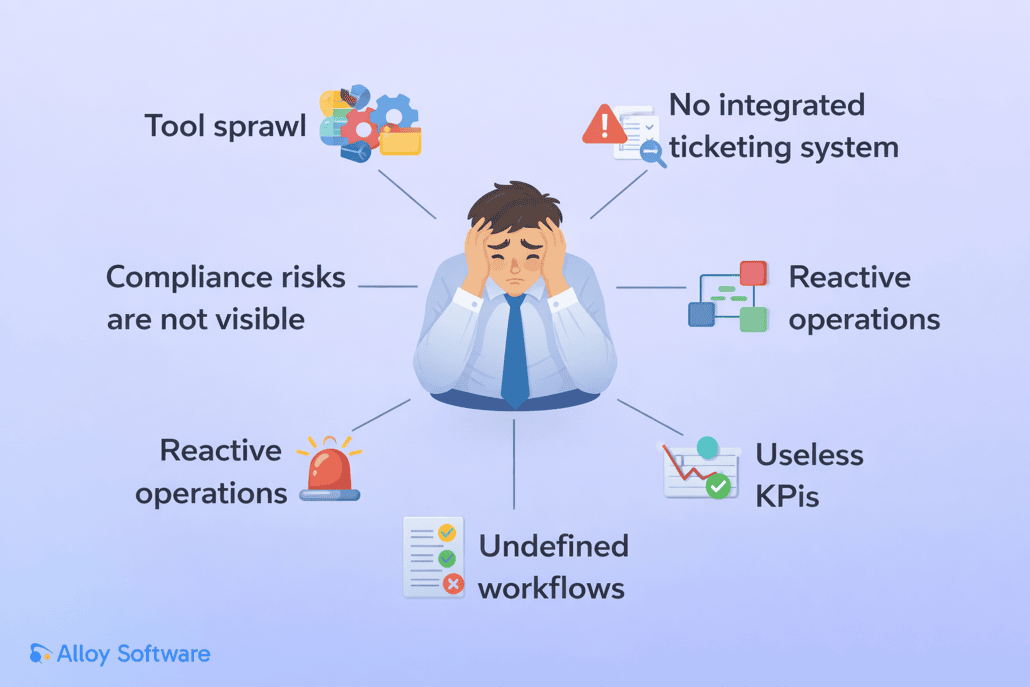
If you work for or lead such an organization, you’ve probably been discouraged by:
In this article, we explore how to design an ITSM strategy that aligns with business priorities, scales with complexity, and a platform that you might want to use to support your strategy shift.
If your current environment feels fragmented — tickets in one system, assets in another, approvals happening over email — consolidation becomes a strategic imperative.
Alloy Navigator is designed for organizations transitioning from reactive firefighting to structured service delivery.
It centralizes incidents, service requests, problems, changes, and IT assets within a single system of record, giving leadership clear operational visibility without relying on tribal knowledge or disconnected reporting.
For example, the All Tickets grid in Alloy Navigator displays records of all Service Desk Tickets, which include:
Moreover, you can see the related configuration items (CIs) in the respective column.
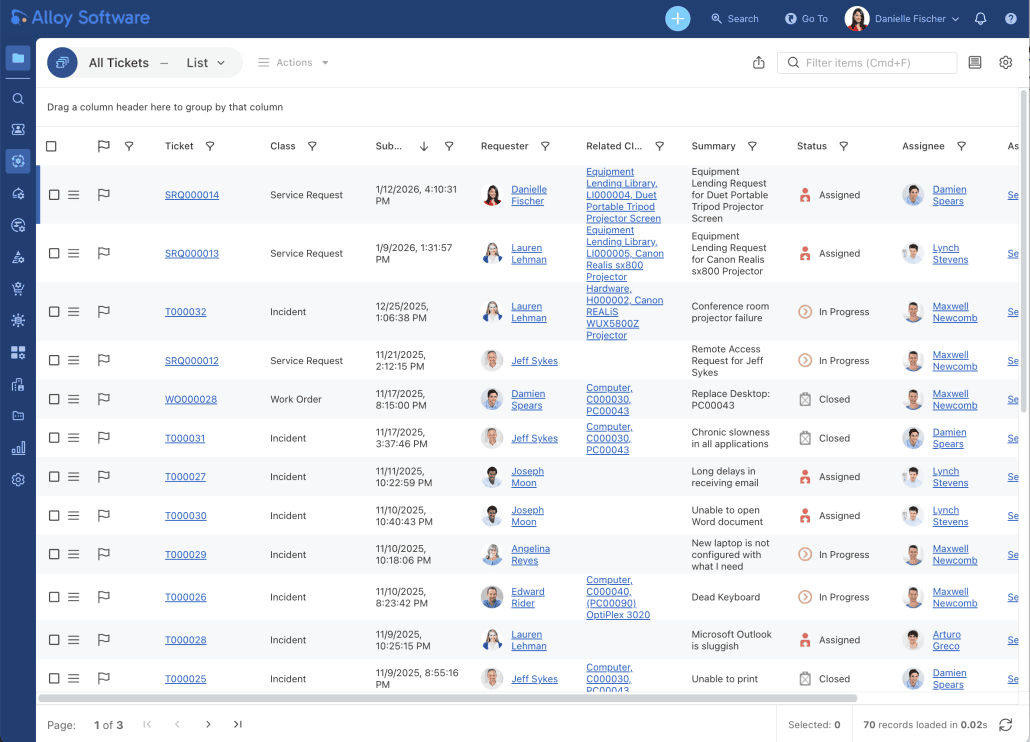
This is just a tiny bit of Navigator’s capabilities. Connect to our sales team to get a demo.
An effective ITSM strategy brings structure to service management by answering a few critical questions about value and accountability.
Every IT capability should trace back to a business requirement. A healthcare provider, a school district, and a manufacturing firm all operate under different risk profiles and service expectations. Strategy makes those dependencies explicit and defines what service failure actually costs the business.
Not all systems deserve the same level of protection, investment, or urgency. A production scheduling platform is not equal to an internal wiki. A mature ITSM strategy establishes clear service tiers based on business impact.
Clear service ownership, defined process accountability, and decision authority reduce delays and unmanaged risk. ITSM strategy establishes governance models that clarify who decides, who executes, who approves, and who owns outcomes.
A utility company’s operational technology environment has different resilience requirements than a retail analytics platform. The strategy anchors these requirements to business context.
Beyond operational KPIs, the strategy defines indicators that matter to leadership—customer-facing availability, cost efficiency trends, business impact reduction, and measurable contribution to business outcomes.
For a detailed breakdown of how to select and structure KPIs that support strategic decision-making rather than reporting compliance, see our article on ITIL KPIs It can help you move from operational metrics to outcome-driven measurement that directly informs governance and investment prioritization.
These questions closely align with the Service Value System described in ITIL 4 Foundation. Frameworks provide structure, but the answers must reflect the organization’s specific business context.
Follow us on LinkedIn for the latest product insights, feature previews, and more exclusive updates.
Strategy documents are easy to produce and easy to ignore. The difference between a strategy that changes how an organization operates and one that gathers digital dust comes down to how it is built, who owns it, and whether it is connected to operational reality.
Begin with an honest evaluation across multiple dimensions.
A structured maturity assessment provides an objective baseline and builds the business case for strategic investment.
The target operating model describes what ‘good’ looks like — not as a list of aspirations, but as a concrete design for how ITSM will function when the strategy is realized. It should specify:
A common mistake in this step is building the target operating model around the tools already in place, rather than designing the model first and selecting tools that support it. The result is an operating model that inherits the limitations of existing technology rather than enabling the operating model the business actually needs.
Full ITSM transformation cannot happen simultaneously across all dimensions. Teams have limited change capacity, and attempting to transform process, tooling, and culture at once typically results in organizational fatigue and partial completion across all three.
Effective roadmaps sequence changes across four categories:
Strategy without governance is an aspiration. The execution infrastructure matters as much as the strategic design. It requires:
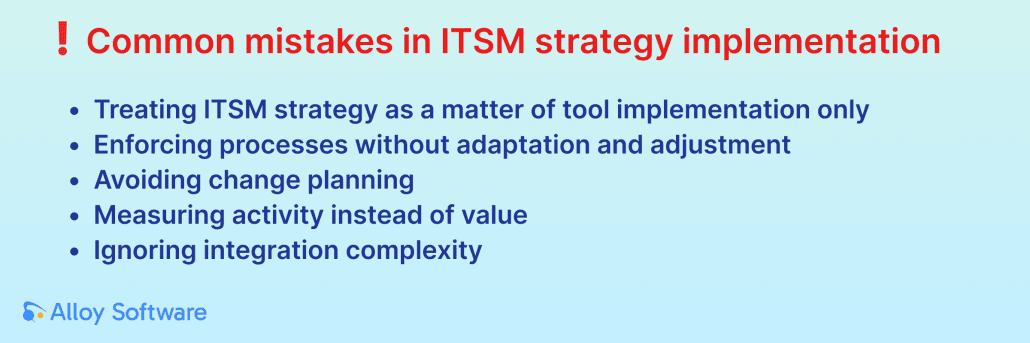
Treating ITSM strategy as a process of tool implementation rather than organizational transformation. Technology enables strategy but doesn’t create it. Deploying a platform without changing processes, roles, or culture simply automates existing dysfunction.
If you are evaluating options specifically for early-stage or high-growth environments, explore our overview of the most popular ITSM platforms for startups. For organizations that need structure without enterprise-level complexity, see our guide to the best ITSM platforms for small businesses.
Alloy Navigator is designed to support your company’s evolution. It provides the structure needed to formalize workflows and governance early on, while remaining flexible enough to scale as operational maturity increases. Rather than forcing a future platform replacement, it allows organizations to grow their ITSM capability on a stable foundation.
Over-standardizing without contextual adaptation. Frameworks like ITIL provide valuable guidance, but they require tailoring to organizational context, culture, and maturity. Rigid adherence to prescribed processes often creates more problems than it solves.
Ignoring organizational change management. ITSM strategy changes how people work, make decisions, and interact. Without addressing the human dimensions—communication, training, incentives, career paths—technical changes fail to stick.
Measuring activity instead of value. Tracking how many changes were processed or how many incidents were logged tells you about volume, not value. Strategic metrics connect to business outcomes and customer experience.
Underestimating integration complexity. Modern IT environments are heterogeneous and distributed. Achieving seamless integration across tools, processes, and teams is technically and organizationally complex. Underestimating this leads to failed implementations and abandoned initiatives.
Modern enterprises operate in fundamentally different technology environments than a decade ago. Hybrid infrastructure spans cloud platforms, on-premises data centers, edge computing, and SaaS applications. Development methodologies range from waterfall to Agile to DevOps to continuous deployment. Security has shifted from perimeter defense to zero trust architecture.
An ITSM strategy must integrate with this reality rather than resist it.
As IT environments grow more complex, an effective ITSM strategy requires more than well-defined processes on paper. It needs a platform capable of translating strategic intent into consistent, measurable execution. Without the right technological foundation, even the most carefully designed roadmap can stall.
Alloy Navigator provides that foundation by combining incident, problem, and change management with integrated IT asset management and a CMDB in one unified environment. Its workflow engine enables structured automation across the service lifecycle — from request submission through approval, fulfillment, review, and continual improvement.
By consolidating service data, configuration relationships, governance controls, and reporting into a single system, organizations gain operational clarity and long-term scalability without adding unnecessary tool complexity.
If your ITSM strategy aims to move beyond documentation and into sustained, measurable execution, Alloy Navigator is designed to support that transition.