ITIL Service Design: How to Create Lightweight Business Services
Learn how modern ITIL 4 Service Design works, which artefacts matter today (SLR, SAC, SDP), and how to create lightweight, business-aligned service models.



Learn how modern ITIL 4 Service Design works, which artefacts matter today (SLR, SAC, SDP), and how to create lightweight, business-aligned service models.
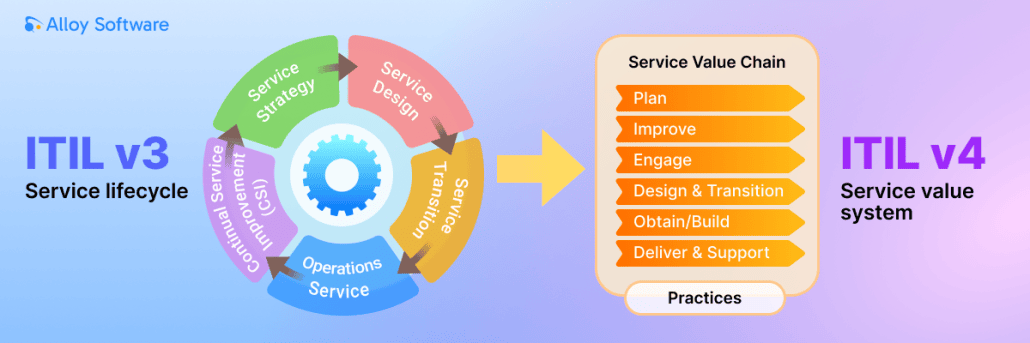
Service Design has always been one of the most influential, yet least visible disciplines within ITIL. In ITIL v3, it existed as a dedicated stage within the ITIL Service Lifecycle, with its own processes and deliverables. In ITIL 4, it evolves into a continuous practice integrated across value streams and co-creation activities.
This shift made Service Design more flexible and aligned with Agile and DevOps, but it also led many organizations to underestimate its importance.
In this article we will bring Service Design back into clarity. Take a closer look at how the discipline works in ITIL 4, what outputs truly matter, and how organizations can modernize traditional ITIL v3 artefacts—SLRs, SACs, and the SDP—without reverting to heavy documentation or bureaucratic overhead.
Anyone transitioning from ITIL v3 to ITIL 4 quickly realizes that the old lifecycle model is gone. Where there used to be a clearly demarcated stage called “Service Design,” ITIL 4 introduces something more fluid: a practice that moves alongside value streams rather than standing as a formal gate.
Follow us on LinkedIn for the latest product insights, feature previews, and more exclusive updates.
This shift encouraged flexibility, but it also caused confusion. If Service Design isn’t a phase anymore, maybe there’s no need to do all this formal design work at all?
The truth is, Service Design hasn’t disappeared. ITIL 4 encourages companies to treat Service Design not as a linear stage but as a continuous and collaborative practice, moving with the service throughout its lifecycle. It has become embedded in planning activities, in architecture decisions, in early requirements, in operational readiness checks, in transition workflows, and in SLA formulation.
You’ve probably seen some of these scenarios in your own environment:
While they may initially appear to be “documentation problems”, they actually stem from decisions that were made without a shared model, without constraints, and without visibility of long-term impacts.
ITIL 4 emphasizes that while good design requires investment, bad design is exponentially more expensive. A 2020 study by Wang & Franke shows that downtime costs often increase faster than linearly, meaning organizations must invest either in reducing outage duration or outage frequency depending on their cost curve—and poor service design typically worsens both.
If a major outage has ocurred despite your best design efforts, having a clear response strategy becomes essential. In our article on Major Incident Management, we break down how to restore critical services fast and keep the situation under control, according to ITIL best practices.
The processes that once formed the backbone of the Service Design lifecycle haven’t disappeared; they’ve simply lost their rigidity. Instead of being executed sequentially, they now act as knowledge domains supporting practical work.

Rather than being treated as standalone processes, these disciplines now sit within a broader context: delivering value in complex, multi-team, multi-supplier ecosystems.
In the ITIL 4 Service Value Chain, Service Design appears as a thread, not a stage. It shapes every phase where decisions need structure and clarity:
When organizations map their value streams, they often notice that many “recurring problems” aren’t operational at all—they are design issues that accumulate and break through.
Bringing Service Design into the value chain makes those issues visible early, where they are cheaper and safer to address.
A typical “Design & Transition” value stream may include stages like these:
You can already see that service design in ITIL 4 is not a single moment, but a continuum.
The value stream perspective encourages teams to stay aligned and communicate more transparently as the service evolves.
In ITIL v3, Service Design was closely linked to formal documents: SLRs, SACs, SDPs, and a number of management plans. In ITIL 4, the approach has become more flexible: the emphasis has shifted from lengthy documents to minimally sufficient artifacts that are developed in conjunction with the product, architecture, engineering, security, and suppliers.
In ITIL v3, SLRs were often long, formalized documents.
In ITIL 4, they evolve into living artefacts that reflect ongoing discussions with customers and product management.
A modern SLR captures:
SLRs should be reviewed frequently and adjusted as business needs evolve. This is especially required in dynamic or high-growth environments.
One of the core philosophical shifts in ITIL 4 is the move toward lightweight documentation. AXELOS repeatedly emphasizes this idea (for example, in The future of ITSM is agile), however, it’s often misunderstood.
“Lightweight” does not mean skipping documentation or relying on tribal knowledge and scattered Jira tickets. It means documenting only what creates service value, and doing so in a way that is clear, minimal, and easy to maintain.
Think of the SDP as a shared playbook that:
SDP is not meant to be a rigid document. It can be a collection of diagrams, structured text, requirements lists, service models, or even wiki pages—as long as it is clear, current, and purposeful.
If you want to understand how ITIL 4’s shift toward flexibility, lean documentation, and value-stream thinking aligns with modern delivery approaches, our comparison of ITIL and DevOps provides a clear, practical overview of where the two complement each other, and where their mindsets differ.
Service Acceptance Criteria define what “ready” truly means for a service. As the ITSM Professor notes, SAC is a key element of Service Validation, confirming that a service meets functional, non-functional, and operational requirements before going live.
SACs bridge design and transition, translating requirements and constraints into clear, verifiable conditions. They cover not only functions but also operational readiness elements such as monitoring, logging, alerts, backups, fault tolerance, support procedures, and required knowledge articles.
In ITIL 4, SACs become part of value streams, serving as quality “gates” applied at various stages—not just at the end of a project. They are updated as part of Continual Validation and Testing, enabling early detection of issues, mitigating risks, and preventing costly rework at later stages.
Capacity & performance profiles describe how a service behaves under different levels of demand and what resources it requires to meet agreed service levels. They translate abstract performance expectations into concrete, measurable patterns that architects, developers, and operations teams can design for.
Patterns of how demand fluctuates during the day or year.
Example: peak traffic from 09:00–11:00 and 14:00–17:00; significantly lower usage on weekends.
Different types of operations and their performance targets.
Example:
“Create order” — up to 120 requests/min, target latency < 150 ms
“Search query” — CPU-intensive, high concurrency
How many users or processes interact with the service simultaneously.
Example: up to 800 concurrent users during business hours; up to 10,000 during marketing campaigns.
How much CPU, memory, I/O, or network throughput typical operations require.
Example: reporting workloads are I/O-heavy and require SSD-backed storage; authentication is CPU-bound during peaks.
Modern services are rarely isolated. They exist in distributed, interconnected environments with failure domains, cross-dependencies, and variable risk exposure. So outages rarely happen discretely: a service may fail due to one cause, but hidden dependencies can prevent recovery, dramatically extending downtime. Because these dependencies are difficult to identify without realistic failover testing, the availability and resilience planning should be a part of design.
Whether the service operates in an active-active setup, relies on warm standby, or follows a different continuity model, the design should state:
Every new or changed service introduces new data flows, integrations, user roles, and operational dependencies—all of which can become attack vectors or sources of regulatory exposure. Early security integration also improves alignment with compliance teams, reduces approval delays, and ensures that the service can enter production without last-minute redesigns or risk exceptions.
Key considerations include:
Addressing these aspects during design prevents architectural gaps that are difficult and expensive to fix later.
As organizations move toward multi-cloud architectures, SaaS ecosystems, and outsourced operations, services increasingly operate as collaborative supply chains. ITSM tools highlights that when suppliers are aligned early—sharing processes, responsibilities, and performance expectations—organizations gain faster delivery, smoother handoffs, more predictable service quality, and stronger operational resilience.
A well-designed service clarifies:
Organizations & people
Service Design relies on clear ownership and aligned expectations. Service owners, architects, product managers, operations teams, and suppliers must understand their roles and how design decisions are made. A shared view of responsibilities reduces ambiguity during transition and early operation and ensures that design artefacts are complete, consistent, and actionable.
Information & technology
This dimension covers architecture, integrations, data flows, automations, monitoring, and tooling. The goal is not exhaustive documentation, but a clear rationale behind technical choices—why the architecture is fit for purpose and fit for use, and how reliability, scalability, and security will be achieved. Capturing these decisions early prevents costly surprises during testing and go-live.
Partners & suppliers
Most services depend on external vendors—cloud providers, identity services, support partners, and data processors. Service Design makes these dependencies explicit and ensures that contracts, SLAs, and shared responsibilities align with the service’s intended utility and warranty. This reduces risk and avoids misalignments between internal expectations and vendor capabilities.
Value streams & processes
Service Design supports every stage of the value stream by defining how work flows end-to-end: required activities, handovers, controls, and expected outputs. Well-designed flows reduce rework, clarify transitions between teams, and ensure that operational and support needs are built in from the start. This enables smoother delivery and more predictable service performance.
Common failures in service design typically arise from several systemic patterns. Below, each pattern is paired with practical actions to prevent or resolve it.
| Pattern | Issue | How to Fix It |
|---|---|---|
| Overreliance on agility and speed | Teams assume Agile delivery removes the need for structured design, early acceptance criteria, or warranty definitions. |
|
| Role and ownership ambiguity | No clear accountability for SLRs, architecture, support readiness, or service acceptance → artefacts degrade or go missing. |
|
| Late discovery of constraints | NFRs, compliance, capacity, or supplier constraints surface during testing or early operations, making changes costly. |
|
| Siloed improvements | Teams optimize locally (faster pipelines, better tooling) without seeing the full value stream → mismatched support, monitoring, continuity. |
|
To see how these pitfalls connect to the broader strengths and weaknesses of the ITIL framework, take a look at our article on ITIL limitations you should know about.
Modern Service Design is no longer about producing large, static documents; it is about creating clarity, shared understanding, and predictable outcomes in environments where change is constant. When organizations treat design as an ongoing practice woven into value streams, they reduce avoidable risks, strengthen alignment between teams, and ensure that services evolve sustainably rather than drift into operational debt.
By reframing classic ITIL v3 artefacts into flexible, lightweight, and collaborative tools—SLRs, SACs, SDPs, capacity profiles, resilience patterns, and support models—teams can make better decisions earlier, build services that scale with business demand, and deliver more consistent customer experience. These artefacts act as enablers of agility, transparency, and long-term value.
Ultimately, the organizations that benefit most from ITIL 4 are those that recognize Service Design as the connective tissue of the service lifecycle. When design becomes a shared discipline rather than a stage to “get through,” it elevates the entire ecosystem—improving delivery, reducing rework, and ensuring that services genuinely support the outcomes they were created to achieve.